
The golden ratio appears in the spiral of a nautilus shell, the branching of a tree, and the arrangement of seeds in a sunflower head. For designers who work with botanical subjects, this mathematical relationship is not a theoretical curiosity. It is a structural code that governs the forms you are trying to capture. Understanding how Fibonacci shapes botanical design changes the way you observe, trace, and reconstruct natural patterns in vector work.
What the Fibonacci Sequence Actually Is
The Fibonacci sequence begins with 0 and 1. Each subsequent number is the sum of the two preceding numbers: 0, 1, 1, 2, 3, 5, 8, 13, 21, 34, and onward. As the sequence progresses, the ratio between consecutive numbers approaches 1.618, known as the golden ratio or phi. This convergence is not approximate in the long term. It is mathematically certain.
This ratio was identified and documented across multiple mathematical traditions. It appears in geometry, architecture, and music theory. In nature, it governs growth patterns that maximize exposure to light, stability in structural arrangements, and efficient packing of components. When a plant grows according to Fibonacci principles, it is not following a rulebook. It is achieving an optimal solution to a physical problem through iterative growth.
Where Fibonacci Appears in Botanical Forms
Sunflower Seed Heads
Sunflower seed heads display perhaps the clearest example. Seeds arrange in spirals that typically follow Fibonacci counts: 34 spirals in one direction and 55 in the other, or 55 and 89 in larger specimens. This arrangement allows the maximum number of seeds to fit in the available space without crowding. Each seed receives equal access to sunlight and nutrients. The pattern is not aesthetic preference. It is physical efficiency.
Pinecones, Succulents, and Leaf Arrangement
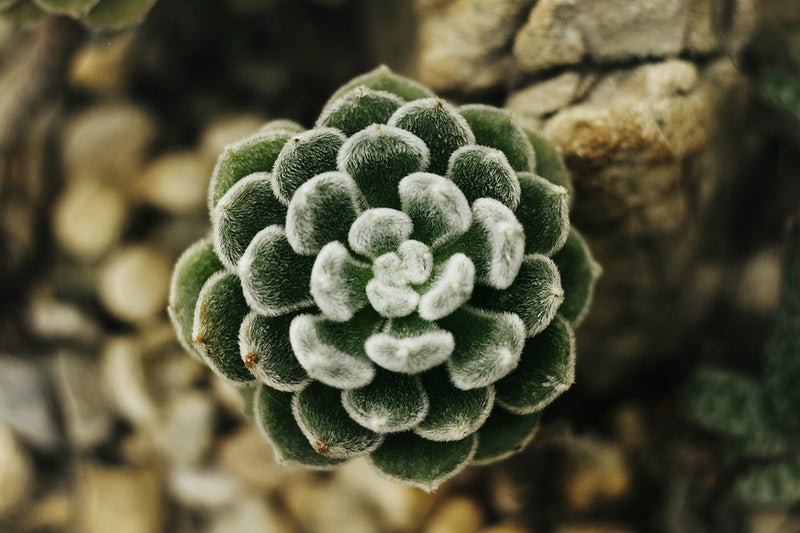
Pinecones show similar spiral counting. Succulents such as echeveria grow leaves in a spiral pattern that follows the golden angle, approximately 137.5 degrees. This spacing ensures each leaf receives optimal light exposure without overshadowing its neighbors. Fern fronds uncurl in a logarithmic spiral governed by the same ratio. The fiddlehead shape you see in spring is a direct expression of this growth pattern.
Flowers and Petal Counts
Peonies, ranunculus, and roses display petals arranged in Fibonacci counts. The outer petals may number 5 or 8, while inner layers follow 13 or 21. The result is a dense, spiraling center that draws the eye inward. When you trace these flowers for vector illustration, recognizing this spiral structure helps you place each petal in its correct relationship to the others. Without this awareness, you draw a flower. With it, you reconstruct a growth process.
Translating Natural Proportion into Vector Work
When you trace a botanical subject that follows Fibonacci principles, you have two approaches. You can copy what you see, placing each element by eye. Or you can reconstruct what is actually there, using geometric construction to guide your path placement. The second approach produces vector files with cleaner anchor point distribution, more logical layer hierarchy, and greater scalability.
It also teaches you to see the underlying order in apparently irregular forms. A leaf that seems randomly curved may follow a precise logarithmic spiral when you overlay a construction grid. Branching that appears chaotic may resolve into predictable Fibonacci counts when you count carefully. This awareness transforms your reference library from a collection of pretty images into a study archive of structural patterns.
In software like Adobe Illustrator or Inkscape, use the spiral tool with a growth factor of 1.618 as a reference layer. Trace your subject against this construction. The resulting paths will align with natural proportion even when you remove the reference grid. The geometry is embedded in the curves, invisible but present.
Using the Golden Ratio as a Composition Guide
Beyond tracing individual subjects, the golden ratio governs effective composition. Divide your artboard using golden rectangles. Place your primary subject at a golden section intersection. Use the ratio to determine spacing between elements. This creates layouts that feel resolved without being mechanically regular. The viewer perceives the coherence without necessarily identifying its mathematical source.
The key is to use these proportions as starting points, not prisons. Botanical forms deviate from perfect mathematical regularity because they respond to wind, moisture, competition, and damage. Your vector work should capture both the underlying order and the natural variation that makes living forms compelling. A perfectly geometric flower would look artificial. A flower drawn with geometric awareness but natural variation looks alive.
Why This Changes How You Design with Natural Patterns
Once you begin seeing Fibonacci relationships in source material, your reference library becomes more than a collection of pretty images. It becomes a study archive of structural patterns. You start selecting reference photographs based on how clearly they display geometric growth principles. You begin to recognize when a botanical illustration has been drawn with geometric awareness and when it has been copied superficially.
This awareness elevates your vector files from decorative assets to precise reconstructions of natural order. The work carries more authority. Clients and viewers sense the difference even when they cannot articulate it. There is a coherence to geometrically informed work that arbitrary placement cannot replicate.
