
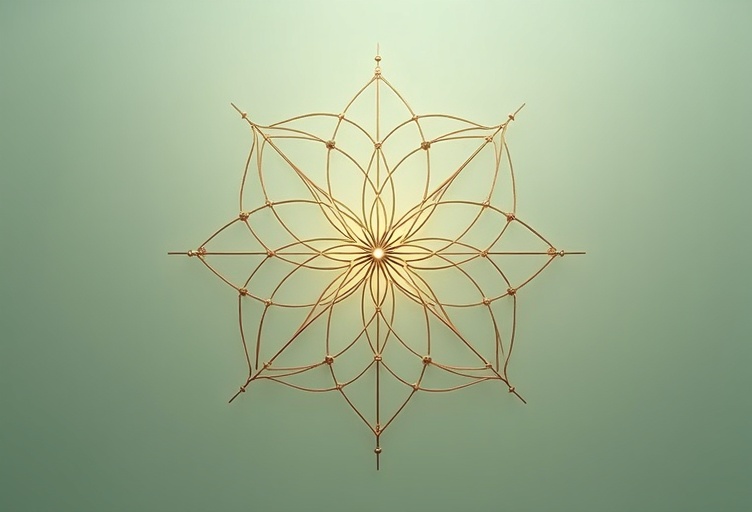
Sacred geometry describes the mathematical patterns and proportional relationships that recur throughout the natural world. These are not decorative trends. They are structural principles that have governed the growth of plants, the formation of crystals, and the architecture of sacred spaces for millennia. For designers who work with botanical and geometric vector files, understanding sacred geometry provides a foundation for building compositions that carry visual weight and intentional structure.
The Core Patterns Every Designer Should Recognize
Several geometric forms appear repeatedly across natural and built environments. The Flower of Life, composed of overlapping circles, has been found in manuscripts and temple floors spanning multiple continents. The Golden Ratio, approximately 1.618, governs spiral growth in shells, pinecones, and the arrangement of sunflower seeds. The Fibonacci sequence underlies the branching of trees and the layering of petals. Platonic solids appear in molecular structures. These are not abstract concepts. They are observable, measurable patterns.
The Flower of Life
The Flower of Life consists of overlapping circles arranged so that the center of each circle lies on the circumference of six surrounding circles. This creates a hexagonal lattice that appears in the cellular structure of plants, the arrangement of honeycomb, and the molecular packing of certain crystals. When used as a construction grid in vector work, it provides a foundation for radial symmetry that feels naturally resolved rather than mechanically regular.
The Golden Ratio and Fibonacci Sequence
The Golden Ratio, approximately 1.618, appears in the spiral growth patterns of shells and the seed arrangement in sunflower heads. The Fibonacci sequence produces this ratio as it progresses: 0, 1, 1, 2, 3, 5, 8, 13, 21, 34. Each number is the sum of the two preceding numbers, and the ratio between consecutive numbers converges toward phi. In botanical subjects, this governs everything from petal counts to branching angles.
Why Sacred Geometry Matters in Vector Design
Vector files rely on mathematical precision. Bézier curves, anchor points, and path operations are themselves geometric tools. Sacred geometry gives you a reason to place those anchor points where they belong. It turns arbitrary placement into informed decision-making. When you understand the underlying structure of a botanical form, you do not merely copy its appearance. You reconstruct its logic.
Consider a botanical illustration of a peony. Without understanding the radial symmetry and logarithmic spiral that governs petal placement, you trace what you see. With geometric awareness, you trace what is actually there. The result is a file with cleaner paths, more logical layer structure, and greater scalability. The difference is visible at large scale and in print, where construction errors become obvious.
How to Apply Sacred Geometry in Your Work
Start by using geometric grids as reference layers. Place a golden ratio spiral or Flower of Life construction behind your subject and align key elements to intersection points. This does not mean your final composition must be geometric. It means the underlying structure supports whatever aesthetic you build on top. The viewer perceives the coherence without necessarily identifying its source.
Work with modular scaling. When you resize a geometric element, maintain the proportional relationships. If a circle represents one unit, its neighbor should respect the same ratio. This creates coherence across the file that clients and viewers perceive even when they cannot name it. The most effective design work often communicates through structure before content.
From Observation to Vector
The transition from observing natural geometry to translating it into vector form requires deliberate practice. Begin by photographing subjects that clearly display geometric structure: spiral succulent growth, radial flower heads, branching fern patterns. Overlay geometric constructions in your drawing software and compare them to your reference. Note where the natural form deviates from perfect geometry and ask why. Wind, competition for light, and damage all introduce variation that makes living forms compelling.
Use software tools to your advantage. Adobe Illustrator’s spiral tool, polar grid, and shape builder all support geometric construction. Inkscape offers similar functionality at no cost. The key is not the tool but the intention behind it. Build a reference layer, trace your subject against it, then hide the construction when you are satisfied. The geometry remains embedded in the paths even when it is no longer visible.
Building a Reference Library
Collect high-resolution photographs of natural subjects that clearly display geometric structure. Cross-reference them with historical illustrations from botanical archives. Compare how different artists and periods interpreted the same forms. This archive becomes your primary source material for original vector work. Over time, you will develop an eye for which reference images contain genuine geometric information and which are merely decorative.
Precision as a Practice
Sacred geometry is not a style. It is a discipline. The more you study these patterns, the faster you recognize them in new subjects. Your files become cleaner. Your compositions become more resolved. Your work carries the quiet authority of something that was built, not guessed. The geometric awareness you develop through this practice transfers to every other aspect of your design work, from typography to layout to color relationships.
